Calculate Waste Grab Crane Capacity for 500–600 TPD MSW
menu_open
Content Quick Link
How to Calculate Waste Grab Bucket Crane Capacity for 500–600 TPD MSW Plants
Quick Review: Key Takeaways
- Crane Sizing Matters: Proper waste grab crane capacity calculation ensures your MSW plant meets daily throughput targets.
- Plan for Real Conditions: Factor in TPD-to-hourly conversion, grab bucket volume, cycle time, and waste density.
- Include Safety Margins: Add 10–20% buffer for variable waste and operational delays.
- Verify with Experts: Always consult your crane manufacturer or supplier to confirm calculations and select the right equipment.
Introduction
Municipal Solid Waste (MSW) plants handle large volumes of waste daily. Waste grab cranes are crucial, linking raw input to processing units efficiently and safely.
MSW Plants and Their Core Function
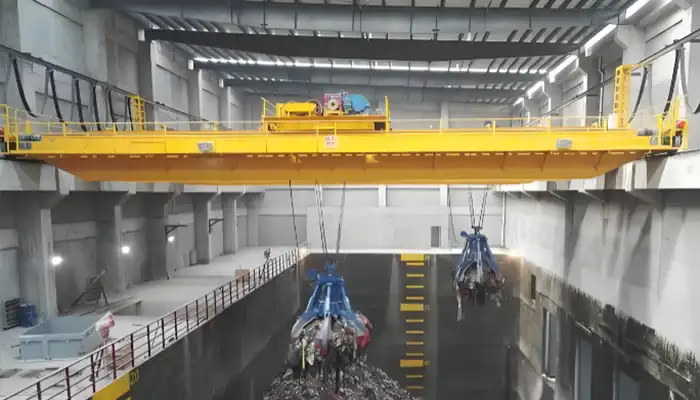
MSW plants handle large volumes of waste every day, ranging from household garbage to industrial refuse. Their main goal is to move, sort, and process waste efficiently before disposal or recycling. In these operations, waste grab cranes play a crucial role. They transport waste from storage pits to shredders, conveyors, or treatment units, acting as the link between raw input and processing.
Why Crane Capacity Matters
Choosing the right waste handling crane isn't just about picking a machine off the shelf. Accurate waste grab crane capacity calculation is essential to ensure smooth operations. If the crane is too small, it can slow down the entire plant. If it's oversized, it increases costs unnecessarily and may even introduce safety risks. Proper sizing balances throughput, cycle times, and safety, ensuring consistent performance day after day.
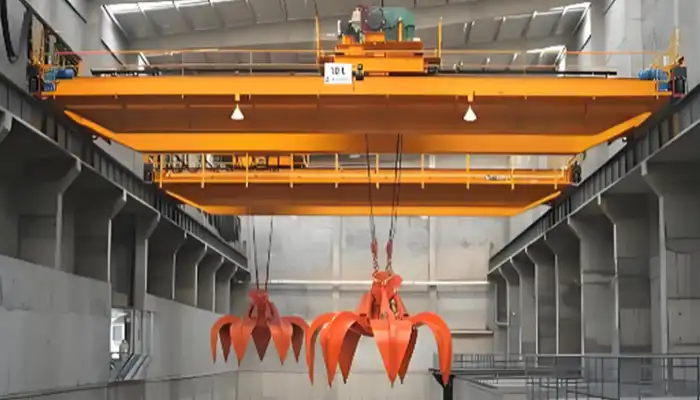
double girder overhead crane with grab bucket for waste handling
Focus on 500–600 TPD Plants
This guide focuses on plants handling 500–600 tons per day (TPD). At this scale:
- The crane must handle several tons per hour consistently.
- Grab bucket size and cycle time become critical for meeting hourly targets.
- Real-world factors like waste density and composition can significantly affect throughput.
- Planning for operational margins prevents overloads and downtime.
Key Takeaways for Readers
Before specifying a crane for your MSW plant, consider these practical points:
- Understand the hourly throughput required to meet daily TPD targets.
- Match grab bucket volume with expected cycle times and waste density.
- Factor in safety margins and variations in waste composition.
- Ensure the crane can physically access all areas of the storage pit without slowing operations.
MSW Throughput Requirements
TPD (Tons per Day) defines the daily waste volume a plant must handle. Correctly interpreting TPD ensures the overhead grab cranes are sized to maintain smooth operations without bottlenecks or unnecessary costs.
What TPD Means and Why It Matters
TPD, or Tons per Day, is a standard way to measure the volume of waste a plant processes daily. For crane sizing, TPD is a starting point. It tells you how much material your waste grab crane needs to move every day to keep operations running smoothly. A crane that can't handle the required tonnage will cause bottlenecks, while a crane that's too large may increase costs unnecessarily.
Converting TPD to Hourly Capacity
To understand the crane's real-world workload, TPD must be converted into hourly throughput, because cranes operate on cycles—lifting, swinging, and dumping—rather than handling the daily total all at once.
Formula:
Hourly Capacity (tons/hour) = TPD ÷ Operating Hours
Example:
- Plant target: 500–600 TPD
- Operating hours: 20 hours/day (allowing 4 hours for maintenance, breaks, or downtime)
For 500 TPD:
Hourly Capacity = 500 ÷ 20 = 25 tons/hour
For 600 TPD:
Hourly Capacity = 600 ÷ 20 = 30 tons/hour
This means the waste grab crane must move 25–30 tons of waste per hour to meet plant goals.
Operational Considerations
Several real-world factors can affect throughput calculations:
- Shift schedules: Longer or shorter shifts change hourly requirements.
- Planned downtime: Maintenance, inspections, or breaks reduce the actual operating time.
- Waste variability: Bulk density and composition affect how much material fits in each grab.
- Operator efficiency and automation: A fully automated crane may maintain consistent cycles, while manual operations can vary.
Factors Affecting Grab Crane Capacity
Several variables influence how much a waste grab crane can lift safely and efficiently. Understanding these factors helps ensure consistent throughput and safe operations.
Waste Density Variability
Not all waste weighs the same. MSW density can vary widely, from light, bulky household trash to heavy, compacted industrial waste. Density is usually measured in kg/m³, and it directly affects how much weight each grab can handle.
- Lighter waste allows larger grab volumes without overloading the crane.
- Denser waste reduces the volume that can be safely lifted per cycle.
- Real-world planning should consider average and peak densities to avoid overloading the hoist or trolley motors.
Waste Composition
The type of waste also matters:
- Bulky waste: Items like furniture or large packaging may limit how full a grab bucket can be.
- Compactable waste: Crushed or compressed waste can increase weight per cycle, even in smaller volumes.
- Mixed waste: Most MSW is a combination, requiring careful balancing between grab size and cycle time.
Crane and bucket design must accommodate these differences to maintain consistent MSW grab crane throughput.
Safety and Operational Margins
It's not enough to design for average waste conditions. Adding safety margins ensures the crane can handle higher-than-expected loads.
- Typically, a 10–20% margin above average waste density is recommended.
- Overdesign prevents stress on motors, ropes, and structural components.
- Operational margins also reduce the risk of downtime caused by overloading or mechanical failure.
In practice, this means calculating grab bucket volume with the worst-case density in mind, not just typical conditions.
Environmental and Space Constraints
Finally, the plant layout affects crane performance:
- Pit size and shape: The crane must reach all areas without hitting walls or obstructions.
- Height limitations: Swing and lift heights influence cycle time and bucket design.
- Other equipment: Conveyors, shredders, and compactors can restrict movement or require careful sequencing.
Grab Bucket Volume Calculation
Determining the correct grab bucket volume is crucial for achieving MSW plant throughput targets efficiently without overloading the crane.
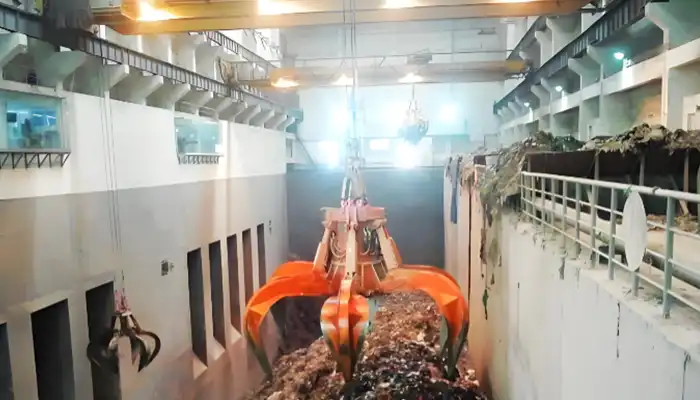
Orange Peel Grab: Hydraulic Grab & Mechanical Grab Bucket
Understanding Grab Bucket Volume
The grab bucket volume determines how much waste the crane can lift per cycle, directly influencing throughput and efficiency. Choosing the right size ensures that the crane meets daily TPD targets without overloading equipment or slowing operations.
Too small, and the crane will require too many cycles. Too large, and it may exceed crane or hoist limits, increasing wear and maintenance costs.
How to Size a Waste Grab Crane
To calculate the ideal grab bucket volume, use the formula:
Required Grab Volume (m³) = (Hourly Throughput ÷ Cycle Rate) ÷ Waste Density
- Hourly Throughput (tons/hour): Derived from plant TPD ÷ operating hours.
- Cycle Rate (cycles/hour): Number of grab-lift-swing-dump cycles per hour.
- Waste Density (tons/m³): Average density of the waste handled.
Example for a 500 TPD Plant:
- Hourly throughput: 25 tons/hour (500 TPD ÷ 20 hours)
- Cycle rate: 15 cycles/hour
- Average waste density: 0.6 tons/m³
Required Grab Volume = (25 ÷ 15) ÷ 0.6 ≈ 2.78 m³ per grab
Each grab bucket should hold roughly 2.8 cubic meters of waste to meet target throughput efficiently.
Cycle Time Considerations
A crane's efficiency depends on both bucket volume and cycle times. Each cycle consists of:
- Grab: Closing the bucket around the waste.
- Lift: Raising the bucket to clear the pit or obstacles.
- Swing/Travel: Moving waste to the discharge point.
- Dump: Opening the bucket to release waste.
Optimizing each stage reduces idle time and increases throughput.
Operator Efficiency and Automation
- Manual operations vary based on operator experience.
- Automated or semi-automated cranes maintain consistent cycle times, allowing slightly smaller grabs without reducing throughput.
- Realistic calculations should consider delays, human factors, and downtime for maintenance or safety checks.
Waste Grab Crane Throughput Optimization
Maximizing MSW grab crane throughput requires balancing grab volume, cycle time, and crane parameters to achieve daily TPD targets efficiently.
Balancing Grab Volume and Cycle Time
Optimizing MSW grab crane throughput is about finding the right balance between grab volume and cycle time. Larger grabs lift more waste per cycle but may take longer, while smaller grabs can cycle faster but may increase crane strain.
Key considerations:
- Larger buckets reduce the number of cycles but increase lifting effort.
- Smaller buckets allow quicker cycles but may increase crane travel and operational strain.
- Always match grab size to the crane's lifting capacity and pit layout.
Adjusting Crane Speed, Reach, and Lifting Height
To hit TPD targets efficiently, adjust crane parameters to suit your plant layout:
- Crane speed: Faster trolleys and hoists reduce cycle time without changing bucket size.
- Reach: Ensure the crane can access all areas of the pit efficiently to avoid extra travel time.
- Lifting height: Minimize lift height when possible—lifting higher than necessary wastes time and energy.
These subtle adjustments can significantly impact waste grab crane capacity over a full operating day.
Using Multiple Grabs or Faster Cycles
Some plants optimize throughput by using:
- Multiple grabs: Two smaller grabs working in tandem can handle more waste per hour in certain pit layouts.
- Faster cycles with smaller buckets: In automated systems, this can be more efficient than a single large bucket.
Safety and Operational Margins
Accounting for variability in waste and crane mechanics ensures safe, reliable operation while reducing maintenance and downtime.
Adding a Buffer for Real Waste Conditions
Waste in MSW plants is unpredictable. Density, composition, and moisture content can vary daily. Engineers typically include a 10–20% safety buffer when calculating waste grab crane capacity.
- This ensures the crane can handle heavier-than-average loads without strain.
- Reduces the risk of frequent stops or slowed operations caused by unexpected high-density waste.
- Planning for variability keeps operations smooth, especially in plants handling 500–600 TPD.
Structural and Mechanical Considerations
Safety isn't just about bucket size—it's about the crane's mechanical limits. Consider:
- Structural load limits: Bridge, trolley, and supporting runway must handle peak loads safely.
- Hoist motor ratings: Motors should operate comfortably below maximum capacity to prevent overheating and premature wear.
- Mechanical components: Ropes, gears, and bearings must accommodate occasional overloads without failure.
Including these considerations during design ensures long-term reliability and reduces maintenance costs.
Avoiding Overloading
Overloading a crane is one of the fastest ways to reduce its lifespan. It can cause:
- Excessive wear on hoist and trolley components
- Structural stress on the bridge or runway
- Increased downtime for repairs
Practical Example Calculation
A step-by-step guide to sizing a waste grab crane for a 500–600 TPD MSW plant, including grab volume calculations and safety margins.
Step 1: Convert TPD to Hourly Rate
Convert the plant's daily target into hourly throughput for accurate crane sizing.
- Plant target: 500–600 TPD
- Operating hours: 20 hours/day (allowing downtime for maintenance and breaks)
Hourly Throughput Calculation:
500 TPD ÷ 20 hours = 25 tons/hour
600 TPD ÷ 20 hours = 30 tons/hour
The crane must consistently handle 25–30 tons of waste per hour to meet daily targets.
Step 2: Select Grab Volume Based on Cycle Time
Determine the grab bucket volume using the expected cycle rate:
Formula:
Required Grab Volume (m³) = (Hourly Throughput ÷ Cycle Rate) ÷ Waste Density
- Average cycle rate: 15 cycles/hour
- Waste density: 0.6 tons/m³
Calculation:
For 500 TPD: (25 ÷ 15) ÷ 0.6 ≈ 2.78 m³ per grab
For 600 TPD: (30 ÷ 15) ÷ 0.6 ≈ 3.33 m³ per grab
Grab bucket should hold roughly 2.8–3.3 cubic meters per cycle.
Step 3: Adjust for Waste Density and Operational Margins
Include a 10–20% safety margin to account for waste density fluctuations and operational delays:
- 2.78 m³ × 1.1 ≈ 3.06 m³
- 3.33 m³ × 1.1 ≈ 3.66 m³
This ensures the crane can handle heavier loads without overloading or slowing operations.
Step 4: Summary Table of Options
| Hourly Throughput (tons/hour) | Cycle Rate (cycles/hour) | Waste Density (tons/m³) | Base Grab Volume (m³) | Adjusted Volume with 10% Margin (m³) |
|---|---|---|---|---|
| 25 | 15 | 0.6 | 2.78 | 3.06 |
| 30 | 15 | 0.6 | 3.33 | 3.66 |
This table helps engineers and plant planners quickly select the appropriate grab size, considering throughput, cycle rate, waste density, and operational safety margins.
Conclusion
Correctly sizing a waste grab crane is more than a design exercise—it directly affects MSW grab crane throughput, plant efficiency, and long-term reliability. Choosing the right grab bucket volume, accounting for cycle time, waste density, and operational margins, ensures the crane can handle daily targets without overloading or slowing down operations.
By planning carefully:
- You maintain consistent throughput even with variable waste conditions.
- You protect the crane and mechanical components, reducing downtime and maintenance costs.
- You optimize energy use and operational efficiency, which is especially critical in 500–600 TPD MSW plants.
For best results, it is always recommended to consult with experienced crane suppliers or engineers. They can verify calculations, adjust for plant-specific constraints, and help select equipment that meets both performance and safety requirements. Early technical consultation can save time, reduce costs, and prevent operational bottlenecks once the plant is running.
Smart Waste Grab Crane | Overhead Crane with Garbage Grab & Auto Swing Control
Next Steps for Reliable Waste Grab Crane Planning
Proper waste grab crane capacity calculation can make or break the efficiency of an MSW plant. To ensure your plant meets daily throughput goals safely and reliably, it's wise to involve experts early in the planning process.
- Technical Consultation: Discuss your plant's specific waste types, pit layout, and operational requirements with experienced engineers.
- Layout Review: Ensure the crane can access all areas of the storage pit efficiently and safely.
- Customized Crane Sizing: Get equipment tailored to your plant's TPD, waste density, and cycle time requirements for optimal performance.
Important Notice: All the calculations and examples provided in this guide are for reference purposes only. For practical projects, always contact your crane manufacturer or supplier. Their specialists can verify calculations, adapt designs to your plant conditions, and recommend the safest and most efficient solutions.
Reaching out for professional guidance not only confirms your calculations but also helps prevent costly mistakes, reduces downtime, and ensures that your MSW grab crane throughput meets expectations from day one.

Article by Bella ,who has been in the hoist and crane field since 2016. Bella provides overhead crane & gantry crane consultation services for clients who need a customized overhead travelling crane solution.Contact her to get free consultation.